Phuhoi - the white-haired fortune bearer
In the misty hills of Somdal, they whisper of Phuhoi, a pale figure with backward feet and hair like smoke. Neither god nor ghost, he walks unseen, blessing few, haunting many. To glimpse him is to be changed. In Somdal, they say: if you see Phuhoi, you never walk home alone.
A folktale from Somdal.
In the mist veiled hills of Somdal, where dawn moves slowly across terraced fields like a hesitant memory, there was a time when the land was believed to be alive with unseen presence. Not in the way stories are told lightly, but in the way truth is carried without needing proof. The people did not speak of ownership or control. They spoke instead of relationship, of balance, of living as part of something larger and older than themselves.
Life, in those early days, was not shaped by struggle alone, but by reverence. To plant a seed was to make a quiet promise to the earth. To cross a stream was to acknowledge something watching beneath the surface. To enter a forest was not an act of claim, but of permission, as though every step required acceptance from something unseen. The people did not stand above the land. They moved with it, as though both were breathing from the same unseen source.
Every stream was believed to have a spirit of its own. Every tree stood like an elder who had seen generations rise and fade without ever speaking. Every stone was thought to hold memory, silent and patient, carrying fragments of time no one could fully understand. To walk without respect was to invite imbalance. To ignore the old ways was to become unseen by the very forces that shaped life itself.
Among the countless spirits, gods, and presences believed to inhabit the world, there were those who governed rain, harvest, fire, birth, and death. Each had a place, each had a name, each had rituals that kept the world in rhythm. But there was one presence that did not sit within any known order, one that existed outside the comfort of naming.
It was called Phuhoi.
The name itself was spoken carefully, never loudly, never casually. It did not belong to prayer or temple or offering. There were no songs for it, no carved images, no altar where its presence could be invited. It existed only in stories, and even those stories were spoken with hesitation, as if language itself might disturb something that should remain undisturbed.
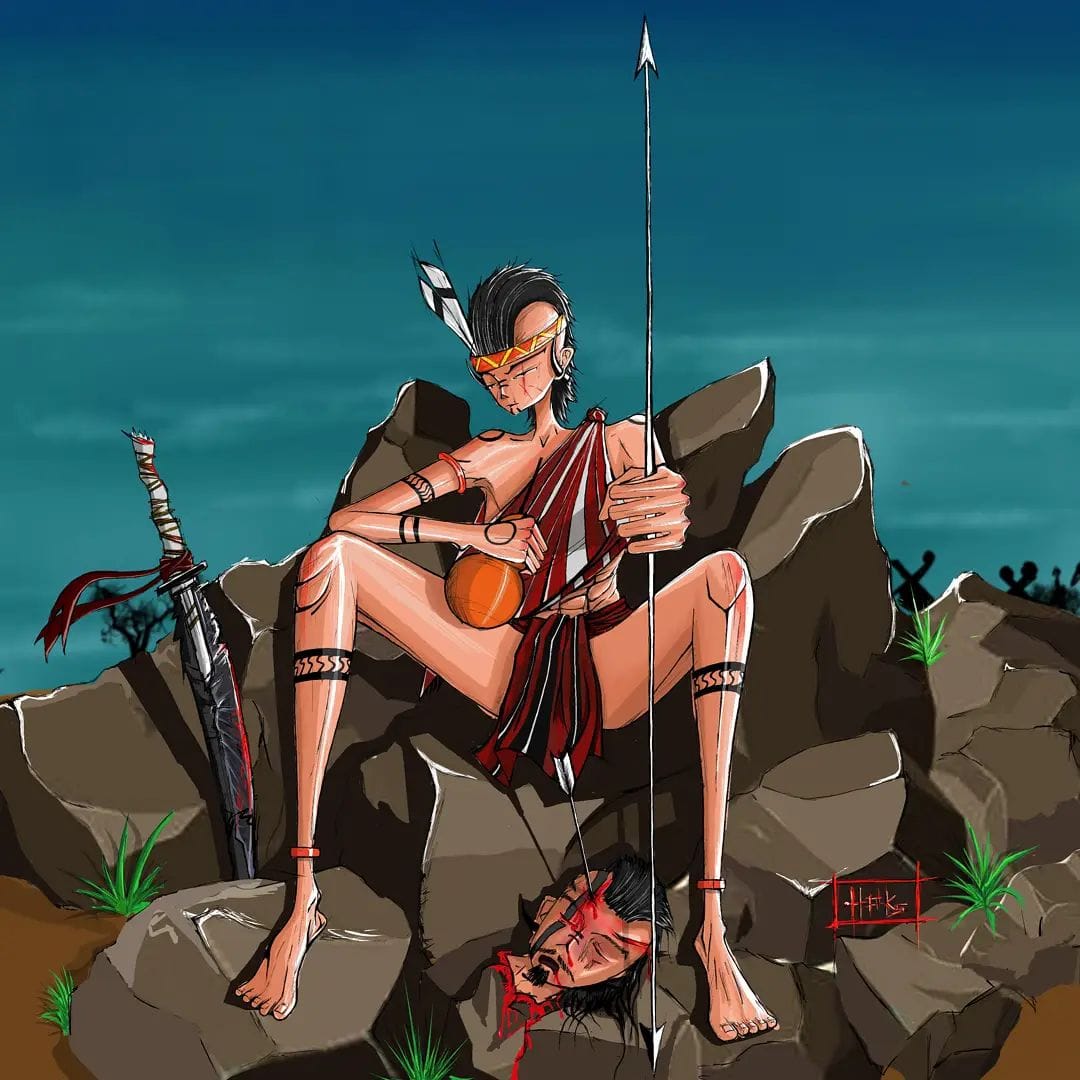
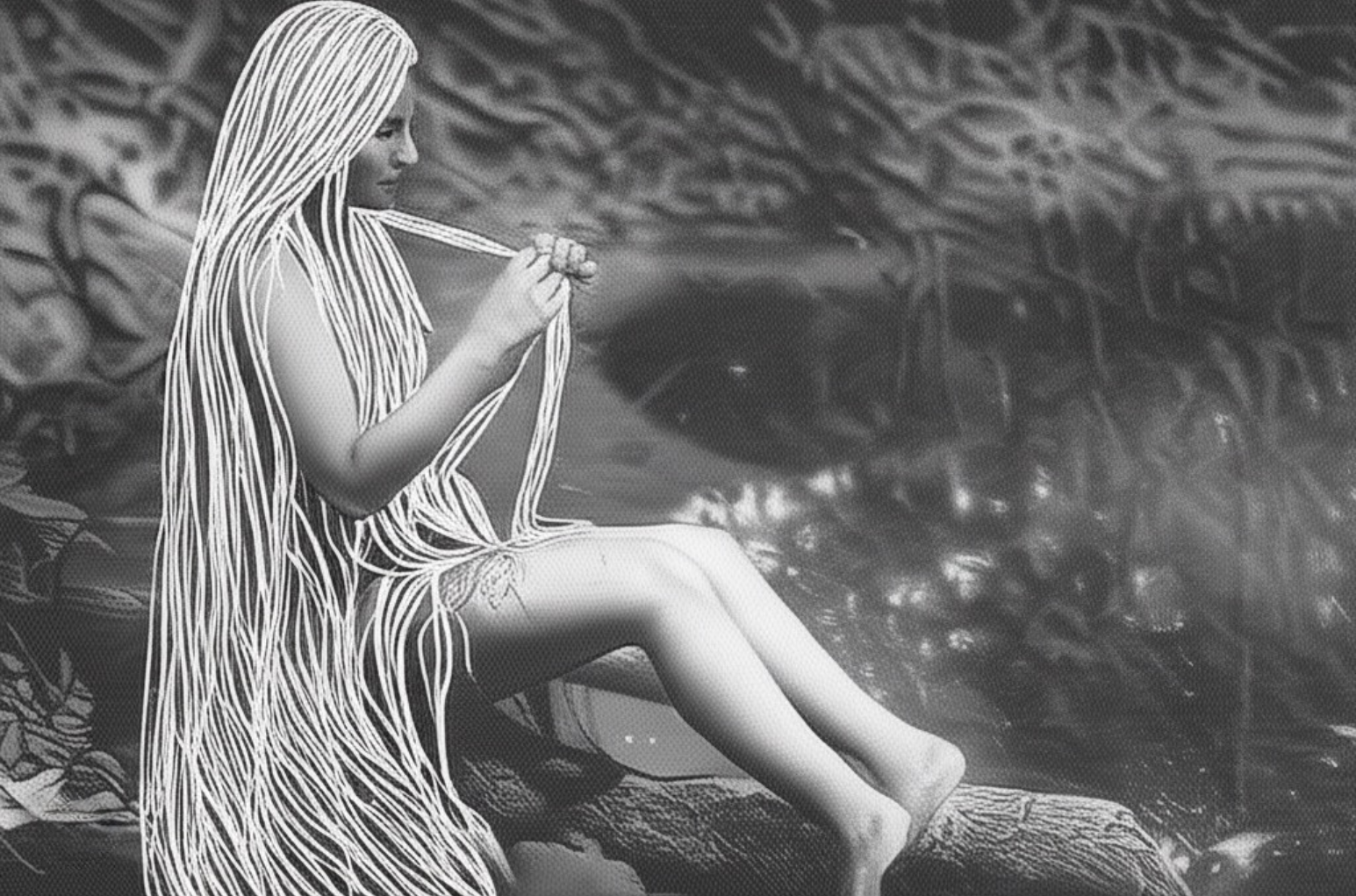
Phuhoi was described in fragments, never fully seen, always remembered differently by each witness. A figure at the edge of vision, thin and pale, neither young nor old, as though it existed before time had decided how age should work. Its long white hair moved like drifting smoke, falling far beyond what seemed possible, trailing across forest floor and stone without resistance. The land did not resist it. The forest seemed instead to carry it gently, as though even the earth treated it with a kind of reluctant respect.
Most unsettling of all were its feet.
They were always backward.
Not twisted in injury, not shaped by accident, but fundamentally wrong in a way that unsettled thought itself. Toes pointed in the direction of departure, heels facing forward as though the body had learned to move against the natural order of the world. No explanation existed for it. None was offered in the stories. It was simply part of what Phuhoi was.
Those who claimed to have seen its tracks said they led nowhere in particular, or everywhere at once. To follow them was to lose certainty. A person might walk in circles without realizing it, returning again and again to the same tree until even the bark seemed to recognize them. Others said following those prints meant surrendering to something that could no longer be named, something that changed direction without moving.
Some believed Phuhoi was born from the very first mist that ever rose from the earth, something ancient and unformed that never fully became part of the world, yet never left it either. Others said it was a punishment cast by the sky gods, condemned to wander endlessly without rest, without name, without belonging. But the elders, those who spoke rarely and with a weight that made others listen, always offered a quieter certainty.
Phuhoi, they would say, simply is.
Not good. Not evil. Not reward. Not punishment. Something closer to wind that cannot be held, or hunger that cannot be satisfied, or the slow inevitability of night falling over the land. A presence that does not explain itself because it was never meant to, and does not need to be understood to exist. And yet, for all its mystery and unease, another name still lingered beside it in whispers carried carefully from mouth to ear.
Hæi Kapho, the bearer of fortune.
Because alongside fear, there was also reverence. It was said that even a glimpse of Phuhoi, even the discovery of a single strand of its white hair, could change a life. A fallen hair was treated like something sacred. It was believed that within it lived the blessings of the forest itself. Crops would grow without struggle. Illness would fade. Wishes, spoken with sincerity, would be answered in ways no one could predict or control. But such encounters were rare. And those who claimed them never experienced them again.
Still, the forest remembers. And so do the people.
There is a story told of a morning in the mist covered fields of Ngotā Khanāi. A family had risen before dawn, as their ancestors had always done, moving through the quiet rhythm of early work. The mist that morning was thick and heavy, not gentle, but alive, curling around their bodies and swallowing the edges of their vision. The terraced fields stretched like soft waves across the hillside, each bund glistening with dew. And then they saw it.
A figure crouched along the narrow bund between fields.
At first, they thought it might be a child who had wandered too far, or perhaps a lost traveler, or even something unwell. But as they stepped closer, hesitation replaced assumption. The white hair became visible first, spilling down like something too long for any human body. Then the pale skin. Then the ribs, rising and falling slowly, as though even breathing was deliberate.
And finally, the feet.
Backward.
The recognition arrived before fear could fully form.
Phuhoi.
It was seated, combing its long white hair with what looked like a shard of bone. Each movement was slow, precise, almost ritualistic. The strands of hair caught the morning dew, shimmering faintly as if holding fragments of starlight. The entire act felt private, as though they had stumbled upon something never meant to be witnessed.
The family froze. Not a sound escaped them. Even breath felt dangerous.
Phuhoi did not turn.
Then, as though the world had briefly forgotten how to continue, everything came to a complete halt. The slow movement of the bone comb stopped mid motion. The air itself felt sealed, heavy with a stillness that was not calm but absolute, pressing in from every direction until even thought seemed quieter than before.
In a sudden movement too swift for the eye to understand, Phuhoi rose and ran.
It was not the kind of running that carries fear or escape. There was no clear direction, no destination the eyes could follow. It was pure motion, as if movement itself had broken free from meaning. The forest did not resist it. The trees remained unshaken, the leaves untouched, and even the wind seemed uncertain whether it had witnessed anything at all.
When it ended, the place simply remained as it was, yet altered in a way that could not be named. The earth showed no mark of passage, the space carried no sound of return, and what lingered instead was a silence deeper than before, as though something had passed through the world and taken a part of its breath with it.
When the family finally approached the place, the ground appeared undisturbed, as if nothing had ever happened there at all. Yet the air carried a strange weight, a subtle charge that could not be explained, as though something invisible had passed through and left its mark without leaving evidence. They stood there longer than they meant to, unsure of what they were feeling, and in the days that followed, the memory of it stayed with them in a way they could not put into words. They spoke of it less and less, until it became something held only in silence.
But what followed was unlike anything they had ever known.
The field began to produce grain in an abundance that defied expectation. Pests did not come near it, as if the land itself had refused them. Storms that passed over the valley seemed to lose strength before reaching it. The rice grew tall, heavy, and unusually rich, catching the sunlight in a way that made the entire field look almost alive.
The elders did not need to see the field, nor did they gather to inspect it. There was no pause of doubt or search for proof. The moment they heard of the sudden change, understanding settled among them quietly and completely, as though the truth had already been known long before it was spoken.
Without discussion or question, they recognized the cause of it. It was not seen as chance, nor dismissed as accident, but understood as something far older in intention, a quiet design that did not reveal itself easily to human understanding. To them, there was only one way to explain it. It was clear that a strand of Phuhoi’s hair must have fallen there unseen, carried into the soil by fate itself and received by the earth without resistance, as though the land had recognized it before anyone else did, allowing its presence to shape the abundance that followed.
That field in Ngotā Khanāi slowly became something beyond ownership or possession. It was never sold, never divided, and never treated as ordinary land. Instead, it passed from one generation to the next as inheritance, not of property, but of memory itself. A living story, tended with reverence and care, spoken about only when necessary, and guarded gently as something both precious and impossible to fully explain.
But there are other stories too, ones that do not belong entirely to distant memory, yet refuse to fade into forgetfulness. They arrive in the present like a living breath, still warm, still unsettled, carried from mouth to ear without ever fully losing their shape.
One such tale is still told in Somdal, especially on nights when the fire burns low and the walls seem to listen more than the people speaking beside them. It is neither ancient nor new, but something that rests in between, unsettled and vivid, still sharp in the minds of those who claim to have heard it directly from those who lived it.
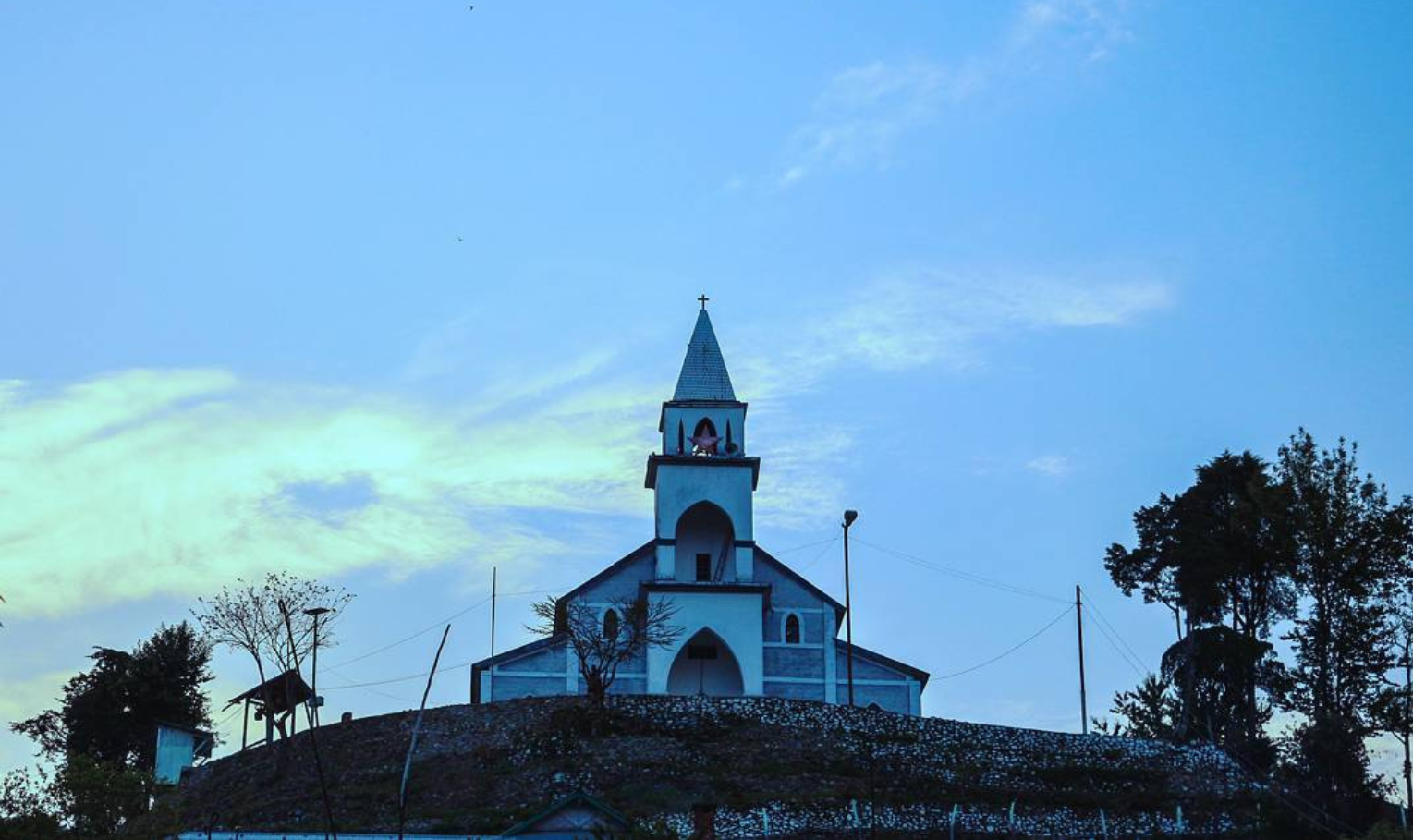
It speaks of a path near Kasomtā, one of the seven sacred settlements of Somdal, high in the hills where mist lingers with a patience that feels almost deliberate, and where the wind moves through stone and leaf carrying the faint scent of wild ginger, as though the land has learned to remember everything it has ever witnessed.
On that evening, two sisters walked the ancestral road together. The sky had only just begun to darken, gold dissolving slowly into ash, as if daylight itself was reluctant to leave. Around them, the forest grew quiet in a way that did not feel natural or gentle, but intentional, as though sound had withdrawn to make space for something unseen.
At Letko, where spring water rises through rock and root during the season of rains, they passed Letyantā and began the gradual ascent toward Phāchāmtā, the hill that villagers still speak of as though its stories never truly fall asleep.
And then they stopped.
Not from fear, not at first, but from something quieter and far more unsettling. A feeling that arrived before thought, before reason, as if the body had recognized something the mind had not yet been allowed to name. It was not a sound they heard, but a presence they felt, as though the forest itself had spoken their names without moving the air. Ahead, where the path curved into shadow and thinning light, a figure stood waiting.
Pale. Motionless. So still it did not seem entirely alive, nor entirely absent, but something suspended between the two. White hair fell down its back like a waterfall that had forgotten gravity. Its body was lean, almost weightless in appearance. And its feet, unmistakably, were backward.
The elder sister felt her breath tighten. The younger whispered what neither of them wanted to believe.
“It is them.”
And then, in an instant, it was gone. Not as something that moved away or withdrew into the trees, but as if the world itself had briefly forgotten how to hold it in place. One moment it was there, still and unmistakable, and the next there was only the empty stretch of path where it had stood, as though even the air had decided not to remember.
They ran after that, without fully deciding to. Their feet moved before their thoughts caught up, voices breaking as they called out into the fading light. By the time they reached the small house of an old woman down the slope, their words came in fragments, breathless and uneven, struggling to shape what they had just witnessed into something that could be shared.
Even then, explanation did not come easily. Language felt too small for what they had seen, too ordinary to carry something that did not behave like ordinary things. So they stopped trying to make it clear, and simply carried it instead.
The memory remained.
Not sharp in the way of fear, but steady, persistent, like something quietly woven into the fabric of their days. It did not fade, nor did it demand attention. It simply stayed, changing nothing on the surface, yet never leaving what lay beneath.
And in time, something began to shift.
In subtle, almost unnoticeable ways, change began to take shape. What once felt blocked gradually loosened. Difficult moments grew lighter with time. Paths that had once seemed closed slowly opened without explanation. Life did not transform in a sudden shift; instead, it eased, like a current finding a gentler course beneath still water.
Some called it coincidence, while others called it luck. But the elders only nodded, as though nothing about it required explanation or doubt. In their silence lay certainty. They had seen Phuhoi. And in Somdal, those who see Phuhoi are never the same again, not in ways that can be spoken aloud, but in the quiet shifts that remain long after memory settles. Because Phuhoi is not a legend that belongs only to stories told beside firelight. Phuhoi is something that walks, something that passes through lives and leaves them changed in ways the world cannot easily name.
Even now, if you move quietly across the bunds before sunrise, when mist still lies close to the fields and the world has not yet fully stirred, you may notice a single white strand resting lightly in the dew. If you find it, do not treat it as something ordinary. Hold it with care, as though even touch must be respectful. Speak your wish softly, with the understanding that some words are heard more deeply than they are spoken.
For Phuhoi does not grant what is asked without thought. It gives only what the forest itself permits, as if every desire must first pass through something older than judgment. It cannot be called, it cannot be kept, and it cannot be claimed. It moves in its own way, leaving behind only faint traces where memory begins to blur into something less certain than truth.
So walk gently through Somdal. Notice when the wind suddenly pauses, as though it is listening. And if the forest feels aware of you in a way you cannot explain, if silence gathers too closely around your steps, do not turn in haste. For there are moments when even direction becomes uncertain, and if you ever glimpse what moves with backward feet, you may realize too late that the path beneath you has already changed, and the way home is no longer the way you remember.