The headless deity and the hunter's bargain
In twilight Somdal, a headless deity offers a hunter a choice: endless rice or endless meat. He chooses meat, gaining unerring hunts but a cursed land. To this day, the fields whisper of the bargain, reminding all that every choice carries a price, and some secrets must remain unspoken.

A folktale from Somdal
In the mist veiled hills of Somdal, where dawn arrives slowly like a hesitant spirit and settles over the terraced fields in soft layers of light, there lived once a man unlike any other.
He was not born of noble lineage, nor was his name ever sung in sacred chants or royal courts. Yet his presence was known in every household, carried quietly from hearth to hearth, from harvest to harvest, like a story that refused to fade. People spoke of him not with reverence, but with a certain wary respect. He was a man shaped by hunger, not only of the body, but of something deeper. Fierce in courage, sharp in thought, and relentless in desire, he was known above all for one thing. His unending craving for meat.
Each morning, before the village fully awakened, when mist still clung to the terraces like sleep that had not yet left the earth, he would walk his fields alone. He would look over the green shoots pushing through the soil, feel the damp ground beneath his feet, and listen to the quiet pulse of land that sustained him. To others, it was peace. To him, it was patience before the hunt.
One morning, as was his habit, the man set out early for his fields while the world was still half asleep. The hills were just beginning to glow with the first touch of sunlight, and the mist lay heavy over the terraces, turning everything soft and pale as if the land itself had not yet fully woken. From a distance, as he walked the familiar path between his fields, something ahead made him slow his steps.
There, on the narrow stretch of earth that divided one field from another, sat a figure. It was completely still, too still for a living being at that hour. It did not seem to belong to the place or the time, as though it had simply appeared out of the silence of the night and forgotten to leave.
The man paused. His breath became quieter without him realizing it, and his usual steady pace broke into caution. His hand, almost by instinct, tightened around the spear he always carried, though he could not yet say why his body had chosen alertness before his mind understood the danger.
A thief, perhaps. An enemy. Or something far worse, something the old stories only spoke of in lowered voices, the kind of stories people stopped telling once the fire burned low and the night grew too quiet. He moved forward slowly, each step measured, reluctant, as though the ground itself had become uncertain beneath him. The figure did not react. It did not shift, or turn, or acknowledge him in any way. It simply remained there, folded into the stillness of the morning, as if it had always belonged to that exact place.
When he finally drew close enough to see it clearly, something inside him gave way. Certainty, instinct, all of it broke at once into a cold disbelief.
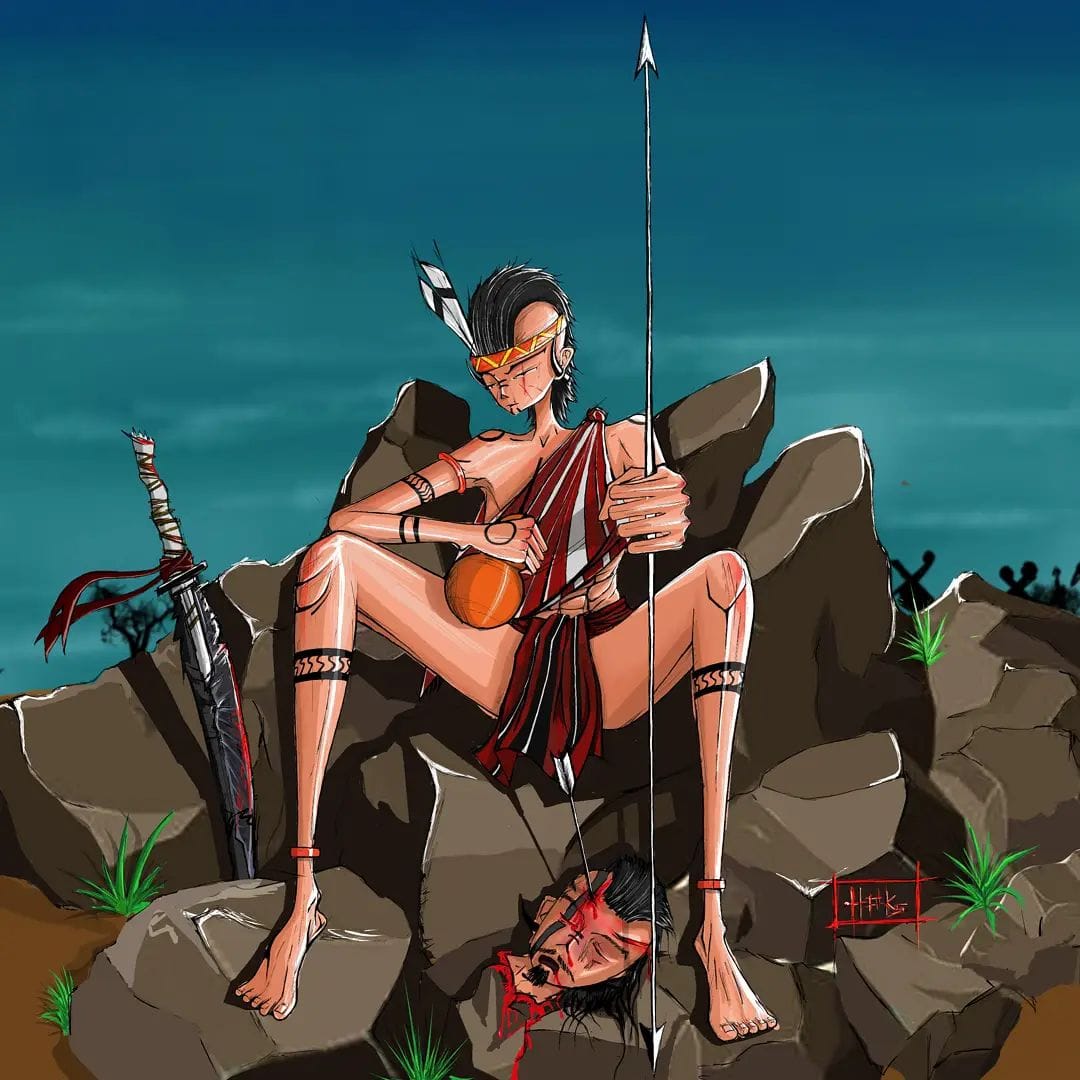
The being had no head.
Yet it sat there as though nothing in the world was out of place, calm and unsettlingly ordinary, as if the absence of a head was no more significant than a change in posture. Its hands moved with a strange, almost careful patience, lightly touching the empty space where a head should have been, like someone adjusting something that had only just been set back in place. The neck beneath was smooth and pale, unnaturally still, and even the morning light seemed hesitant, as if unsure whether it was allowed to reveal what it was seeing.
Fear moved through the man like cold water seeping into bone, slow and numbing, yet he did not step back. Something deeper anchored him there, a mixture of curiosity, disbelief, and the unsettling sense that turning away would not be permitted, as if fate itself had decided this moment could not be escaped.
And then, without warning, he shouted.
A fierce cry tore out of him, raw and unrestrained, born more from instinct than thought. It shattered the stillness of the hills like thunder breaking open a sealed sky. In an instant, birds erupted from the trees in frantic waves, wings beating against the air as if the forest itself had been startled awake. The world seemed to jolt with that sound, as though reality had briefly lost its balance. And in that fragile instant, what should not have moved suddenly did.
The headless figure shifted with a sudden, precise motion, too quick for the eye to fully follow. In a movement that defied sense or understanding, it lifted its head and placed it back onto its body as calmly as one would settle a weight onto a shoulder, as if nothing had ever been wrong at all. The man stood rooted in place, spear still raised but no longer steady in his grasp. His courage, once sharp and certain, now felt tangled and distant, replaced by something deeper and older than fear, something that made even his breath feel uncertain in his chest.
Then the being spoke.
The voice was not loud, yet it filled the space around them completely, as if sound itself had nowhere else to go. It trembled like wind moving through hollow wood, carrying a strange resonance that was neither fully human nor entirely something else. Each word seemed heavy with age, as though it had been spoken before in countless forgotten moments, across places and times no one could name.
“Spare me,” it said, calmly. “And I will grant you one wish. Only one. But you must swear never to speak of this day. Not to your wife. Not to your children. Not even to the wind that passes your door.”
The man hesitated.
Even the forest felt different then, as if it had drawn closer, listening without sound, holding its breath around them.
At last, he spoke, his voice careful and uncertain. “What can you give me?”
The being’s gaze moved slowly across the land, resting first on the wide upper field, then drifting to the smaller patch below, as though it was not measuring soil or distance, but something far more intimate, something like desire itself laid bare.
“You may choose,” it said at last. “Shall your fields yield rice without end, filling your life with certainty and plenty through every passing season? Or shall the forest itself open before you, so that every hunt ends in success, as though the wild has agreed to bow to your hand alone?”
Silence stretched between them, heavy and unbroken, pressing into the space where words had stopped.
The man stood still, and for a moment his mind wandered toward safety, toward overflowing granaries and years that would never know hunger. Yet just as quickly, another feeling rose within him, quieter but stronger, a heat that lived beneath thought. He imagined the chase, the rush of movement through forest and shadow, the living tension of pursuit, the taste of reward earned through struggle rather than given without cost.
“I choose meat,” he said at last. His voice held steady, though something subtle within him had already begun to shift, as if the decision had reached deeper than thought alone. “Let rice feed the body. But meat, meat feeds the soul.”
The being studied him in silence for a long moment, its gaze unreadable, lingering as though it was searching not for what he said, but for what lay hidden beneath it. Then, without change in expression or tone, it spoke once more.
“So be it.”
And then there was no sound, no movement, no sign of departure. It simply was not there anymore, as if it had never occupied the space at all. Only a faint stir of air remained where it had stood, brushing lightly across the field like a passing breath. Yet in that stillness, there lingered a subtle weight, an unspoken presence, as though something unseen had quietly settled into the land and chosen not to leave.
From that day onward, the man never returned from the forest empty handed. Whether the season was harsh or kind, whether the skies withheld rain or poured it freely, it no longer seemed to matter. Deer would appear before him without fear, as if they recognized something in him that did not belong to ordinary men. Wild boars crossed his path with a strange calmness, as though guided rather than wandering. Even birds, which once fled at the slightest sound, now seemed to drift toward him instead of away. The forest, once wild and resisting, no longer pushed him back. It yielded, quietly and completely.
Years passed in this way. His strength slowly diminished, his body growing thinner with age, his hair turning white like ash after fire. His steps became slower, and his breath shorter, but something within him never softened. The hunger for the hunt remained unchanged, as constant as it had been in his youth, perhaps even deeper with time.
Even in old age, he still walked into the forest alone.
And when death finally came for him, it did not find him lying in weakness or stillness at home. It found him where he had always returned, within the silence of the trees. It is said that a deer once entered his home without fear, as if it already knew what was coming. And with whatever strength remained in him, he met it as he always had, without hesitation, without change.
He died as he lived, a hunter still burning quietly from within.
But the story does not end with him.
In Somdal, even today, the elders still speak of his land with a quiet unease, the kind that settles into conversation without needing to be explained. The upper field, once said to be wide and generous, now yields less than the smaller patch below it, as though something in the earth itself has shifted its memory. The soil, they say, remembers something, even if no one can clearly say what was taken or what was left behind.
Some dismiss it as coincidence, a simple change of seasons, or the natural unpredictability of land and weather. Others explain it away as nature doing what it has always done, indifferent and unchanging in its own way. But those who still hold onto the older ways of seeing the world speak differently. They believe it is the mark of a bargain that was never meant to be spoken of again, a reminder that anything taken from the unseen world always demands a balance in return.
And if you walk those same terraces at dawn, when mist still clings to the soil and the world has not yet fully opened its eyes, there are those who say you may feel it too, a faint pressure in the air, as though the land itself is quietly remembering what it has chosen not to forget, alongside a subtle whisper of something unseen, a presence that watches without sound, waiting without urgency.
Beware a hunger that can never be satisfied, and never speak of what you see, for in Somdal even silence carries consequence, and a bargain once made is never truly forgotten.