The Song of the Severed
In ancient Somdal, warriors earned glory by collecting enemy heads. But when one young hunter returns with his bloody trophy, the forest answers, not with silence, but with song. A severed head sings beneath the moonlight… and the jungle forgets no blood. Nor does it forgive.
A folktale from Somdal
In a time when the earth was still young and the breath of the gods was said to move with the wind, the forests of Somdal stretched endlessly, wild and untouched. The land was not divided by roads or borders as it is today. Instead, thick jungle, deep valleys, and hidden trails separated one village from another, and only a few who knew the language of the wild could move safely between them.
In those days, life was shaped by survival rather than law. There were no coins, no written rules, only the instinct to endure and the honor earned through strength. A man’s worth was measured by what he brought back from the forest. A tiger’s tooth, sharp and shining like fire, was worn with pride. A bear’s claw, tied to the chest with sinew or cloth, told others that the wearer had stood face to face with death and returned alive. But above all symbols of courage, there was one that stood higher than the rest.
The taking of human heads.
To enter another village’s land was to step into danger. Neighboring settlements were not neighbors in peace, but rivals shaped by suspicion and old blood. Conflict was not rare in those times. It was part of life, as natural as rain or thunder rolling through the hills. And when warriors returned from battle, they did not speak only of victory. They carried proof.
A severed head was not seen only as violence. In those ancient beliefs, it was pride, authority, and recognition all bound together. The more heads a warrior brought home, the more his name grew in the village, and the more respect he commanded. When the time came for choosing a bride, it was such warriors who were honored first, their strength and reputation deciding their place among the people.
They fought with what the forest gave them. Bows strung with animal sinew, spears carved from hardened wood, and blades shaped from stone and sharpened patience. There was no metal shining in those days, no machines, no distant weapons. Only breath, muscle, courage, and the raw edge of instinct separating life from death.
Among them was a young hunter from Somdal. Strong in body, but still untested in the deeper weight of war. One morning, before the mist had fully lifted from the valleys, he left the village alone. He carried only his spear and the quiet fire of ambition in his chest. He did not speak of what he hoped to become, but in his heart, he believed the forest would remember his name.
But the forest, as always, was already watching.
Deep among the tangled roots and shadowed leaves, he met another warrior. A man painted in ash, his eyes hardened by old violence and unspoken vows. There were no words between them. Only recognition. Only fate.
The fight was sudden and merciless.
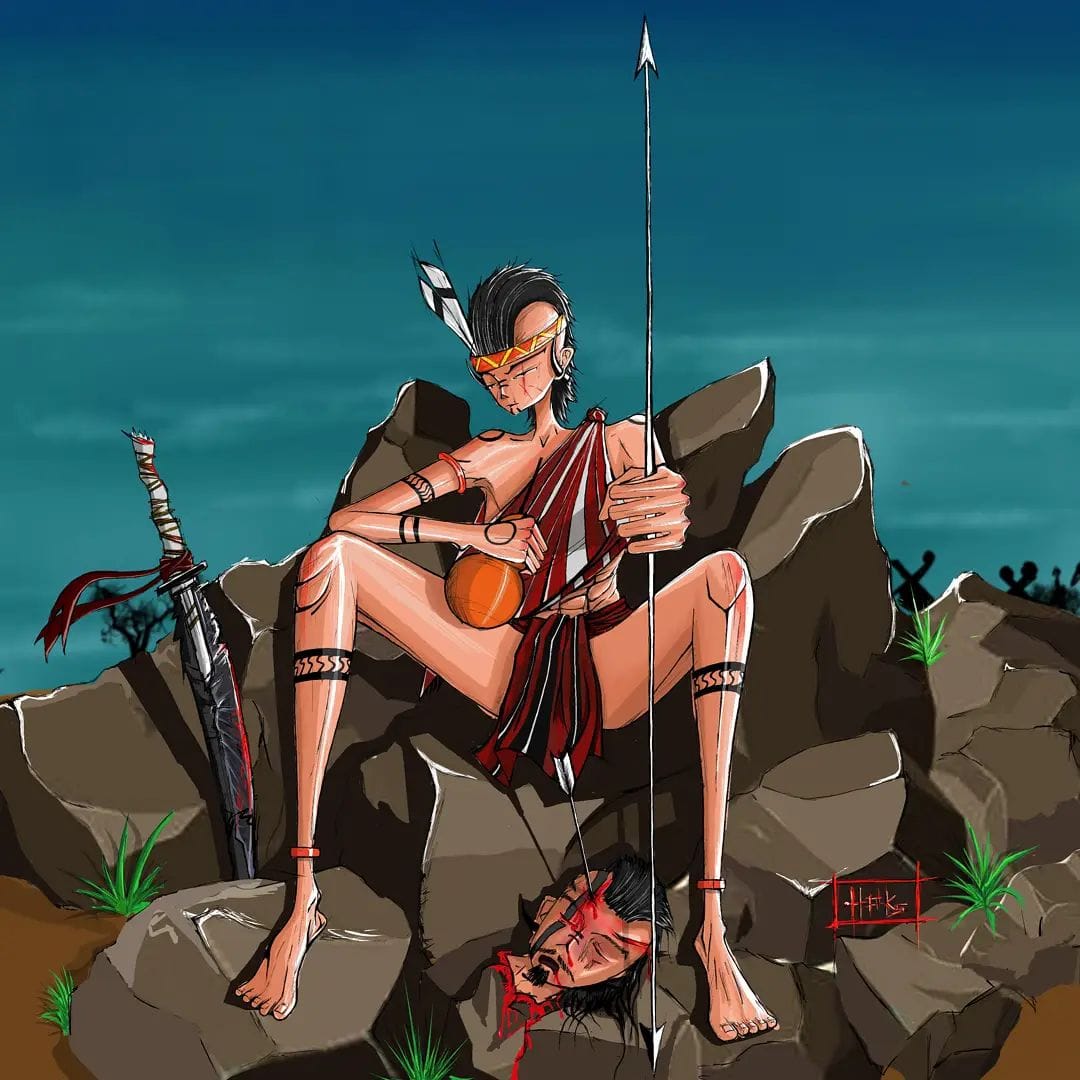
Spears struck, bodies clashed, and the forest echoed briefly with the sound of struggle before falling silent again. When it was over, only the young hunter of Somdal remained standing among the broken leaves and disturbed earth.
He stood still for a long moment, breathing heavily, as though even victory felt heavier than he had imagined. Then, as tradition demanded, he knelt. With careful hands, almost solemn rather than proud, he severed the head of his fallen enemy and lifted it. Blood marked his arms, but his expression carried something closer to disbelief than triumph.
He began his journey home.
The forest behind him grew quieter as the sun sank lower. Shadows stretched across the ground like long fingers pulling the light away. What had once felt familiar began to change. The trees no longer felt like companions of the day. They stood taller, darker, more watchful. By the time night arrived, the jungle was no longer the same world.
The wind had changed its tone. The rustling of leaves became something else, something that sounded like waiting. The hunter, once proud of what he carried, now felt an unfamiliar weight pressing against his shoulders. It was not only the weight of the head. It was something deeper, as though the forest itself had begun to look back at him.
As he approached the edge of Somdal, where the village lights should have been, the darkness thickened. No fires welcomed him. No voices called his name. Even the usual sounds of night seemed to retreat, as if the world itself had fallen into silence. Fear, slow and creeping, began to rise in his chest. And then he called out, his voice breaking through the stillness.
“O people of Somdal, your son returns with the proof of his strength. But the night is heavy and unkind. Bring fire, bring light, and guide me home.”
His words faded into the forest without echo, swallowed by the thick silence that had fallen over the night. From the direction of the village, there was no reply, no flicker of light, no sign that anyone had heard his desperate call. The stillness deepened, pressing against him from all sides, until it felt as though even the air had stopped breathing.
Then, in that unnatural quiet, something answered. It did not come from the wind or the rustling trees, nor from any place he could point to or understand. It came instead from the severed head resting cold upon his shoulder. From it rose a voice, low and unfamiliar, shaped with an eerie rhythm that blurred the line between speech and song, as though the forest itself had begun to speak through what he carried.
“Chilā chān kha chilā chān, kailai milā nou?”
"Moonbeams cover the earth in light, yet you still call for flame?"
The hunter stopped as though the earth itself had halted beneath him. His breath locked in his chest, refusing to move in or out, and his body stood rigid, no longer answering his will. And then the voice returned once more, slower and deeper, wrapped in a cold stillness, as though it had been waiting patiently for him to finally understand its meaning.
“Chilā chān kha chilā chān, kailai milā nou?”
The moon above seemed distant now, as if it no longer belonged to him. The shadows around him deepened, and the path he had walked began to dissolve into darkness. What had once felt like pride now felt like something far heavier, something he could not name.
The head was no longer a symbol of honor. It had become something far older and far more wrong, as if it was never meant to be carried at all.
Some say the hunter never reached the village that night, that the forest took him back and erased his name from memory. Others believe he still walks those old paths, lost between victory and fear, forever guided by the voice that rose from what he once carried with pride.
And from that night onward, something changed in Somdal.
The stories of the elders grew quieter when they spoke of war. Hunters began to walk with more caution, as if the forest was no longer only land, but witness. It is said that even now, when the jungle is still and the moon hangs pale above the trees, a faint voice can sometimes be heard among the wind.
“Chilā chān kha chilā chān, kailai milā nou?”
A reminder, not of glory, but of consequence, of what lingers long after the act is done and cannot be undone. For in Somdal, the forest does not forget what is taken within it, and it remembers in ways the living cannot escape.